Śāstrīya Śraddhā
Śrīla Prabhupāda
Books
Lectures
Letters
Back to Godhead
Diaries
Photos
Books
Lectures
Audio
Search
Gallery
More
About
Bhajans
Persons
EN
v
☀
Śrīla Prabhupāda
Overview
Books
Lectures
Letters
Back to Godhead
Diaries
Photos
Books
Lectures
Audio
Search
Gallery
More
About
Bhajans
Persons
EN
v
☀
Books
A. C. Bhaktivedanta Swami Prabhupāda
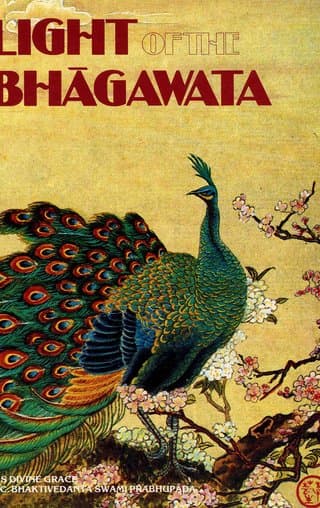
Light of the Bhāgavata
Light of the Bhāgavata
★
◆
Aa
Favorite texts
No favorite texts yet.
Bookmarks
No personal bookmarks yet.
Notes
No notes yet.
Start reading
Preface
Text One
1. The arrival of clouds, accompanied by thunder and flashes of lightning all over the sky, provides a picture of life-giving hope. Covered by deep bluish clouds, the sky appears artificially dressed. The thunder and lightning within the clouds are signs of hope for a new way of…
Text Two
2. The scorching heat of the sun evaporates water from the seas, rivers, lakes, and reservoirs, and there is little water anywhere. The people become thirsty and always look overhead for rain, but in despair. Yet just at the right moment, torrents of rain begin to fall everywhere…
Text Three
3. Attracted by electricity throughout the sky and driven by forceful winds, clouds gradually cover the surface of the earth to satisfy the needy people by supplying water, which is the substance of their life. The clouds bestow rains upon man as the mercy of the Lord, who is alw…
Text Four
4. After heavy rain showers, the fields and forests in all directions appear green and healthy. Thus they resemble a man who has undergone severe austerities for some material gain and has achieved his end, for such a man is strong, hearty, and good-looking. The greenery of the r…
Text Five
5. The evening in the rainy season is dark all around. There is no sight of the twinkling stars on the horizon or the pleasing moon. They are covered by clouds. And the insignificant glowworms become prominent in the absence of the luminaries in the open sky. As there are seasona…
Text Six
6. On hearing the sound of the torrential rains, the frogs come out of the mountain caves and begin to chant, like brahmacārīs who chant the Vedic hymns by the order of the spiritual master. In this age of a godless civilization, the sages of world-recognized religious sects who…
Text Seven
7. The small rivulets that almost dried up during the months of May and June now begin to overflow their banks, like upstarts that suddenly overflow the limits of expenditure. One should learn gravity from the sea and the rivulet. The sea is always within its limits, in spite of…
Text Eight
8. The colorful greenery of the newly grown grass, the seasonal flowers, the frog's umbrellas, the butterflies, and the other variegatedness of the rainy season perfectly represent a well-to-do family absorbed in vanity over their personal assets. A rich man displays his opulence…
Text Nine
9. A picturesque scene of green paddy fields enlivens the heart of the poor agriculturalist, but it brings gloom to the face of the capitalist who lives by exploiting the poor farmers. With good rains, the farmer's business in agriculture flourishes. Agriculture is the noblest pr…
Text Ten
10. Just as a living being attains a transcendentally attractive form by rendering service to Lord Hari, similarly, all the in habitants of the land and the water assume beautiful forms by taking advantage of the newly fallen water. We have practical experience of this with our s…
Text Eleven
11. In the rainy season, when the rivers swell and rush to the ocean, and as the wind blows the waves about, the ocean appears to be agitated. Similarly, if a person engaged in the mystic yoga process is not very advanced in spiritual life, he can be affected by the modes of natu…
Text Twelve
12. The mountains, although being struck by torrents of rain during the rainy season, are not shaken, just as those whose hearts are dedicated to the transcendental Personality of Godhead are never disturbed, even when harassed by great misfortune. Because a person who is spiritu…
Text Thirteen
13. In the rainy season some of the roads are not frequently used and become covered with long grasses, and thus it becomes very difficult to see the road. Similarly, in this age the transcendental scriptures are not properly studied by the brāhmaṇas. Being covered by the effects…
Text Fourteen
14. The lightning becomes unsteady in its friendship, failing to remain faithfully in any one of the clouds, although they are the friends of the entire world, just as lusty women do not remain steady even in the company of men who possess excellent qualities. During the rainy se…
Text Fifteen
15. In the midst of the thunder in the cloudy sky there appears a rainbow that has no string. Its appearance is compared to the appearance of the Supreme Personality of Godhead or His servants in the midst of the material atmosphere. The Sanskrit word guṇa means "quality" or "mod…
Text Sixteen
16. At night, by the grace of the moonlight, the clouds in the sky can be seen moving. Yet the moon itself also appears to be moving, just as a living being appears to be moving because of false identification with matter. At night in the rainy season the moving clouds reflecting…
Text Seventeen
17. When the clouds appear in the sky the peacock begins to dance in ecstasy, as a sincere soul becomes overwhelmed with joy on the appearance of a saint at his house. The duty of sages and saints is to go from door to door and thus enlighten the householders in spiritual knowled…
Text Eighteen
18. Many plants and creepers that were almost dead during the months of April and May are now visible again in various forms, for they are nourished by their roots in the moist earth. These numberless plants and creepers resemble persons who dry up in severe penances for some mat…
Text Nineteen
19. A crane stands on the edge of a pond that is always disturbed by flowing water, mud, and stones. The crane is like a householder who is disturbed in the shelter of his home but who, because of too much attachment, does not want to change his position. The forgetful householde…
Text Twenty
20. Fierce torrents of rain break over the strands and the partition walls of the paddy field. These disturbances resemble those created by the seasonal opponents of the standard principles of the Vedas, who are influenced by the age of Kali. Originally the path of self-realizati…
Text Twenty-One
21. The wind carries the clouds to different parts of the globe, and the clouds distribute rains, to the satisfaction of the people in general, just as rich kings and merchants distribute their accumulated wealth, inspired by religious priests. As already explained, the four divi…
Text Twenty-Two
22. After the complete rainy season, the forest of Vṛndāvana was full of fruits like dates and blackberries ripening on the trees and bushes. Lord Śrī Kṛṣṇa, along with His elder brother, Śrī Baladeva, and other cowherd boys of the vicinity, entered the beautiful forest, accompan…
Text Twenty-Three
23. The cows that followed the Lord within the forest moved slowly because of their heavy, milk-laden udders. But when the Lord called them by their specific names they at once became alert, and as they hastened toward Him their milk bags overflowed and poured milk on the ground…
Text Twenty-Four
24. When the Lord entered the forest of Vṛndāvana, all the inhabitants of the forest, both animate and inanimate, were eager to receive Him. He saw that the flowers of the forest, all fully blossoming, were weeping in ecstasy, honey flowing down their petals. The waterfalls on th…
Text Twenty-Five
25. The Lord reciprocated the feelings of the inhabitants of the forest of Vṛndāvana. When there was rainfall, the Lord took shelter at the feet of the trees or in the caves and enjoyed the taste of different fruits with his eternal associates the cowherd boys. He played with the…
Text Twenty-Six
26. The Lord enjoyed in the company of Lord Baladeva and the other cowherd boys and sometimes sat with them on the same stone slab. While sitting they ate simple food like rice, dal, vegetables, bread, and curd, which they had brought from their homes and which they shared in fri…
Text Twenty-Seven
27. After good rains the grazing ground for the animals was full of green pasture, and both the bulls and the cows sat down on the grass fully satisfied. The cows, followed by their calves, appeared tired of grazing, because of full milk bags. Calmly and quietly the cows and calv…
Text Twenty-Eight
28. The fully beautiful scenery after the rainy season was attractive to the eyes of everyone, including Śrī Kṛṣṇa, the cause of all causes. We should always appreciate the creative energy of the Supreme Lord. Beautiful nature, even though material and therefore temporary, is alw…
Text Twenty-Nine
29. Thus the rainy season came to an end. The autumn began, and there were no more clouds in the sky. All the reservoirs of water became crystal clear, and the wind was no longer forceful. Lord Kṛṣṇa, along with His elder brother, Lord Baladeva, lived at Vṛndāvana in this auspici…
Text Thirty
30. In autumn all the reservoirs of water become enriched with growing lotuses. The muddy water again becomes normally clear and decorated, just as fallen, conditioned souls once more become spiritually enriched in devotional service. We should not be disappointed in our muddy li…
Text Thirty-One
31. The four prominent features of autumn are that there is no water in the sky, the weeds that grew here and there in the rainy season all wither away, the muddy roads and fields dry up, and the ponds of water become crystal clear. These four features of the autumn atmosphere ar…
Text Thirty-Two
32. The beautiful white clouds, freed from all burdens of water distribution, float in midair, like mendicants freed from all family responsibilities. As long as one is attached to the so-called responsibilities of family burdens, he is always full of cares and anxieties about me…
Text Thirty-Three
33. There are waterfalls flowing from the hills of the forest, but sometimes water does not flow from them. So the waterfalls are not like ordinary rainfall. They are compared to great reformers, who speak or do not speak, as the time requires. There are two different kinds of re…
Text Thirty-Four
34. Small pools of water accumulate during the rainy season, and in the autumn they gradually dry up. The little creatures playing in those small pools do not understand that their days are now numbered and will end very soon. Thus they are like foolish men who, not caring for th…
Text Thirty-Five
35. When the small pools of water become too hot because of the scorching heat of the autumn sun, the poor, small creatures, with their many family members, suffer terribly, as poor householders with too many family members suffer economic strains and yet go on begetting children…
Text Thirty-Six
36. With the progress of the autumn season the moist earth and muddy places begin to dry up, and the green vegetation begins to fade. This drying up and fading resembles the gradual disappearance of the false sense of affinity and ego. Progress in cultivating the human spirit ent…
Text Thirty-Seven
37. With the inauguration of the autumn season the rough sea becomes calm and quiet, just like a philosopher after self-realization, who is no longer troubled by the modes of nature. The result of self-realization is cessation of the storms of desire and lust, which are products…
Text Thirty-Eight
38. After the rainy season, the farmers begin to rebuild the partitioning walls of the paddy fields so that the water will be conserved, just as yogīs try to use their conserved energy for self-realization. The living being is the marginal energy of the Absolute Personality of Go…
Text Thirty-Nine
39. In the autumn there is a gulf of difference between the day and the night. During the day the extreme heat of the sun is unbearable, but at night the moonlight is extremely soothing and refreshing. Similarly, Lord Śrī Kṛṣṇa is soothing for both the gopīs and the mundane man i…
Text Forty
40. In the clear autumn sky the twinkling stars appear brighter and brighter, just like a transcendentalist clear vision of the purpose of the Vedas. It is said that the import of the Vedas becomes clear to one who is not only a sincere devotee of the Lord but also a sincere serv…
Text Forty-One
41. In the clear sky of autumn, the beautiful moon among the beautiful stars becomes the cynosure of all eyes, just as Lord Śrī Kṛṣṇa is the central attraction in the Vṛṣṇi dynasty or in the family of Yadu. The Personality of Godhead, Śrī Kṛṣṇa, appeared in the family of Yadu, an…
Text Forty-Two
42. At night in autumn the atmosphere is pleasant because it is neither very hot nor very cold. The mild wind blowing through the gardens of fruits and flowers in Vṛndāvana appeared very much pleasing to all—all but the gopīs, who were always overtaken by heartfelt sorrow in the…
Text Forty-Three
43. In the autumn season all the birds, beasts, and men become sexually disposed, and the bull, the stag, the male bird, the man, and other male creatures forcibly impregnate the fair sex. A similar impregnation takes place as a result of devotional service to the Lord. Devotiona…
Text Forty-Four
44. In the autumn season all the reservoirs of water are full of lotus flowers. There are also flowers that resemble the lotus but are of a different class. Among them is a flower called kumuda. When the sun rises, all the flowers but the kumuda blossom beautifully. Similarly, lo…
Text Forty-Five
45. After the new grains were cut and brought home from the paddy fields, the people began to observe the navānna ceremony everywhere, in the presence of the Lord as Śrī Kṛṣṇa and Baladeva. According to Vedic culture, learned men consider all natural products, such as food grains…
Text Forty-Six
46. The merchants, preachers, kings, and students who were confined to home during the four months June, July, August, and September began to flow out and attain success in life, just as perfected souls attain the required body as soon as they leave the present one. The people in…
Text Forty-Seven
47. From the Transcendence, which is called Kṛṣṇaloka, there emanates a glowing effulgence that resembles the tail of a comet. This glowing effulgence is unlimited, immeasurable, and unfathomable. Within this effulgence there are innumerable glowing planets, each of them self-lum…
Text Forty-Eight
48. The moon, or Candraloka, is one of the four important places of residence for the demigods. Beyond Mānasa Lake is Sumeru Mountain. On the eastern side of this mountain is the planet Devadhānī, where Indra resides. On the southern side is the planet known as Saṁyamanī, where Y…
English
Selected
Russian
Spanish
Brazilian Portuguese
Translation and commentary · A. C. Bhaktivedanta Swami Prabhupāda
BBTI edition
BBTI edition
Selected
BBT edition